Pawbertons
Dog Knee Brace – ACL & Cruciate Ligament Support for Hind Leg
Dog Knee Brace – ACL & Cruciate Ligament Support for Hind Leg
Couldn't load pickup availability
The cruciate ligament is the most common thing to go wrong in a dog's back leg. It usually happens in an unremarkable moment - a turn on wet grass, a jump off the sofa - and then the leg comes up and stays up. What follows is weeks of restricted movement, an anxious vet visit, and a dog who does not understand why they aren't allowed to run.
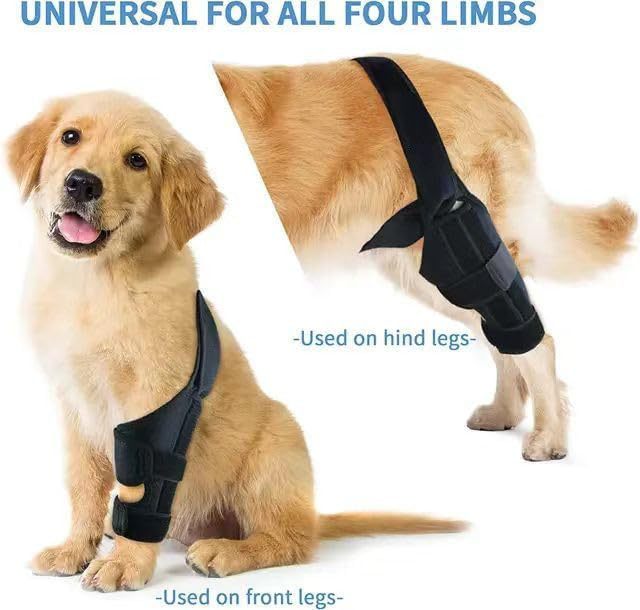
This dog knee brace supports the stifle joint through that period. It wraps the hind leg above and below the knee, with internal stays running the length of the joint, limiting the sideways instability that makes an injured knee painful - while still letting your dog walk.
What A Knee Brace Actually Does
It resists the wrong movement. An unstable knee doesn't just bend, it slides and rotates. The rigid stays running down each side of the brace push back against that shear, which is where most of the pain comes from.
It compresses. Firm, even pressure around the joint helps manage swelling in the days after an injury or a procedure.
It changes how your dog moves. Dogs wearing a brace place the foot more deliberately and are noticeably less likely to attempt the jump onto the bed. A large part of the benefit is simply that the dog is aware of the leg.
When Owners Use It
- Cruciate ligament injuries - partial tears, and conservative management of dogs who aren't surgical candidates
- Post-operative support after TPLO, TTA or lateral suture repair, once your vet has cleared a soft brace
- Luxating patella, where the kneecap slips out of its groove
- Arthritis in the stifle in older dogs, making short walks tolerable again
- The waiting period between diagnosis and a surgery date, when the dog still has to get outside to toilet
- Physiotherapy and rehab, for controlled, supported movement
Built For Daily Wear
- Internal support stays. Firm vertical strips flank the joint to resist sideways collapse without locking the leg straight.
- Two independent straps. Upper and lower wraps adjust separately, so you can set thigh and shin tension to fit your dog's actual shape rather than an average one.
- Long anchoring strap. The extended top strap secures the brace over the hip so it doesn't slide down the leg - the single most common failure of cheaper knee wraps.
- Durable polyester. Keeps its shape through repeated washing instead of stretching out after a fortnight.
- Four sizes, XS to L. Fitted from real leg measurements.
- Either hind leg. Reverse the orientation for left or right.
Size Chart
Measurements below are of the brace itself, laid flat. The upper and lower panel widths are the maximum circumference each wrap will close around.
| Size | Brace height | Upper wrap (thigh) | Lower wrap (below knee) | Approximate breed guide |
|---|---|---|---|---|
| XS | 6 in / 15.2 cm | 9 in / 22.9 cm | 7 in / 17.8 cm | Toy breeds - Chihuahua, Yorkshire Terrier, Pomeranian |
| S | 7.2 in / 18.3 cm | 11 in / 27.9 cm | 8.5 in / 21.6 cm | Small breeds - Dachshund, Shih Tzu, Jack Russell, Miniature Poodle |
| M | 8.5 in / 21.6 cm | 13 in / 33 cm | 10 in / 25.4 cm | Medium breeds - Beagle, Cocker Spaniel, French Bulldog, Border Collie |
| L | 10 in / 25.4 cm | 15 in / 38.1 cm | 12 in / 30.5 cm | Large breeds - Labrador, Golden Retriever, German Shepherd |
How To Measure Your Dog
The breed guide above is a starting point, not an answer - two Labradors can be a size apart. Measure with your dog standing:
- Thigh circumference, around the widest part of the upper leg above the knee.
- Lower leg circumference, just below the knee joint.
- Joint height, from mid-thigh down to mid-shin, covering the knee.
Choose the size whose wrap widths are slightly larger than your dog's measurements - the straps need overlap to fasten securely. If your dog falls between two sizes, take the larger one.
Fitting It Correctly
The opening of the brace must face the inside of your dog's leg. This is not a detail - fitted the wrong way round, the stays sit in the wrong plane and the brace provides almost no lateral support.
Slide the brace up the hind leg so the joint sits centred in the opening. Fasten the lower strap first, then the upper, then run the long anchoring strap up and around the hip and secure it. Both wraps should be firm enough that the brace doesn't rotate when you gently twist it, loose enough that two fingers slide underneath.
Check the leg every couple of hours on the first day. A paw that feels cold, looks swollen, or any redness at the strap edges means loosen it. Build wearing time up gradually rather than going straight to a full day, and take it off overnight unless your vet says otherwise.
Specifications
| Product type | Dog knee (stifle) brace with internal support stays |
| Material | Polyester |
| Colour | Black |
| Sizes | XS, S, M, L |
| Fits | Left or right hind leg |
| Fastening | Adjustable upper and lower straps, plus hip anchoring strap |
| Orientation | Opening faces the inside of the leg |
| In the box | 1 × knee brace |
Care
Hand wash in cool water with mild detergent and air dry flat. Keep it away from radiators and tumble dryers - heat warps the support stays, and a warped stay never fits the same again. If your dog wears it daily, a second brace on rotation means you're never fastening a damp one.
Frequently Asked Questions
Can a brace replace cruciate surgery?
For a full cruciate rupture in an active dog, generally no - surgery remains the standard treatment, and it's worth hearing your vet out on that before deciding. Where braces genuinely earn their place is in partial tears, in dogs who can't undergo anaesthesia, during the wait for a surgery date, and in supported recovery afterwards. Anyone selling you a brace as a cure for a torn ligament is overselling it.
My dog is limping but hasn't been seen by a vet yet.
Get them seen first. A limp can be a bruise, a torn ligament, a luxating patella, or bone cancer, and those need completely different responses. Bracing an undiagnosed leg can hide a problem that's quietly getting worse.
It keeps sliding down the leg.
Almost always the hip anchoring strap. If it isn't secured up and over the hip, gravity and a moving thigh will work any knee brace downwards within minutes. If the strap is secured and it still slides, the size is too large.
Can my dog wear it all day?
Not at first, and not overnight without veterinary advice. Continuous wear without breaks is what causes pressure sores at the strap edges.
My dog keeps chewing at it.
Usually a fit problem rather than stubbornness. Take it off and check the skin underneath for rubbing before assuming it's behavioural.
Is this for front legs too?
No - it's shaped for the stifle, which is a hind leg joint. For front-limb support or whole-body mobility help in weaker dogs, see the braces and lift harnesses in our Dogs collection.
A Note On Measurements
Sizes are measured by hand and may vary by 1–2 cm. Colours can appear different across phone and monitor screens depending on lighting and calibration - the item itself is the accurate reference.
Browse the rest of our recovery, mobility and everyday care range in the Dogs collection.
Share