Pawbertons
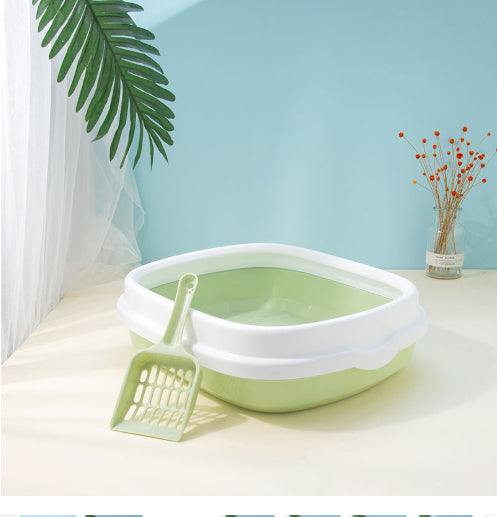
Large Cat Litter Box - Detachable High Rim, Anti-Splash Open Tray
Large Cat Litter Box - Detachable High Rim, Anti-Splash Open Tray
Couldn't load pickup availability
The standard advice from vets and feline behaviourists is that a litter tray should be at least one and a half times the length of the cat, measured nose to base of tail. Almost nothing sold in a supermarket meets that.
The result is the problem half of cat owners quietly live with: litter kicked across the floor, a cat perching on the rim, waste left uncovered because there was nowhere to dig, and - often enough - a cat who starts going somewhere else entirely.
At 55.5 × 45 cm, this tray gives an average adult cat room to turn around, dig properly, and cover afterwards.
The Rim Comes Off
A high rim clips onto the tray and catches litter kicked up the sides - the main reason litter ends up on the floor rather than in the box.
The useful part is that it detaches. On fixed high-sided trays, the join between wall and base is where waste and damp litter collect, and it's almost impossible to clean properly. Unclip the rim and you're washing two simple shapes with nothing trapped between them.
Open, Which Many Cats Prefer
Hooded boxes appeal to owners because they hide the contents. Plenty of cats feel differently about them: a hood concentrates odour, restricts the view, and leaves only one way out - which for a cat sharing a house with another cat or a dog can be enough to make the box feel unsafe.
An open tray with high sides is the compromise most cats accept: containment where it matters, no roof, and a clear line of sight in every direction.
Being straight about the trade-off: an open tray won't contain odour the way a hood does, and a cat who sprays high while standing will need higher walls than any open design offers.
Details
- Generous 55.5 × 45 cm footprint - room to turn, dig and cover
- 16.5 cm depth plus the detachable rim for splash and scatter control
- Clip-off rim that lifts away for cleaning
- Rounded internal corners, so waste doesn't wedge into a sharp angle
- Smooth moulded plastic that rinses clean and doesn't absorb odour
- Four colours - Pink, Blue, Grey and Green
To choose: measure your cat from nose to the base of the tail, and multiply by 1.5. That's your minimum tray length. Kittens can start smaller, but they grow into an adult-sized tray faster than most people expect - buying for the adult cat usually saves buying twice.
Getting Litter Trays Right
The tray is only part of it. A few things make more difference than most owners realise:
- One tray per cat, plus one. Two cats means three trays. Cats are reluctant to share, and the second-most-common cause of accidents around the house is simply not enough boxes.
- Keep them apart. Two trays side by side count as one tray to a cat. Put them in different rooms.
- Away from food and water. Cats won't toilet next to where they eat, and will choose somewhere else if you make them.
- Quiet, but not cornered. A cat wants privacy and an escape route. Behind a door that swings shut, or in a spot with only one way out, will eventually be rejected.
- About 5–7 cm of litter. Too shallow and they can't dig; too deep and many cats won't step in.
- Scoop daily. The single biggest factor in whether a cat keeps using a tray.
If Your Cat Suddenly Stops Using The Tray
Worth saying plainly, because it's often mistaken for behaviour: a sudden change in toilet habits is frequently medical. Cystitis, urinary infections and crystals all make using the tray painful, and cats associate the pain with the place.
A male cat straining without producing urine is an emergency - a blocked bladder can become life-threatening within hours. Go to a vet immediately rather than changing the litter and waiting.
Once medical causes are ruled out, then look at tray size, location, litter type and cleaning frequency.
Specifications
| Product type | Open cat litter tray with detachable high rim |
| Material | Moulded plastic |
| Dimensions | 55.5 × 45 × 16.5 cm (large) |
| Rim | Detachable |
| Colours | Pink, Blue, Grey, Green |
| In the box | 1 × litter tray with rim |
Care
Scoop daily and change the litter completely every week or two depending on litter type and how many cats use it. When you do, unclip the rim and wash both parts with warm water and unscented soap.
Avoid bleach, ammonia and strongly scented cleaners. Ammonia smells like urine to a cat and can encourage them to re-mark the spot; heavy fragrances put many cats off the tray entirely. Rinse thoroughly and dry before refilling - damp plastic makes fresh litter clump to the base.
Frequently Asked Questions
Will it stop litter getting on the floor?
It will reduce it substantially. The rim catches what's kicked up the sides, and the size means most digging stays inside the tray. Nothing eliminates tracking entirely - a mat outside the tray handles the rest.
Is it big enough for a Maine Coon or a large cat?
Measure yours and apply the 1.5× rule. A large breed cat may need the extra large option rather than this one.
Does it work with clumping litter?
Yes, and with crystal, wood pellet and paper litters. The smooth base scrapes clean easily with a scoop.
Can I use it for a rabbit?
The shape works well for rabbits and other small pets who use a corner. Litter choice differs, though - use a paper or wood-based litter rather than clumping cat litter.
Is a scoop included?
No, the tray comes on its own. Scoops and litter accessories are in our Cats collection.
How many should I buy?
One per cat plus one. It sounds excessive and it's the advice that solves the most problems.
A Note On Measurements And Colour
Dimensions are measured by hand and may vary slightly. Colours can appear different across phone and monitor screens depending on lighting and calibration - the item itself is the accurate reference.
Find litter accessories, grooming tools and everyday essentials in our Cats collection.
Share